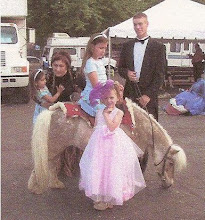
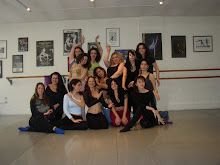
Showing posts with label Student Information. Show all posts

Sacred Props

When I was six years old, mama Rhea took her sword, finger cymbals, black liquid eyeliner and all the belly dance costumes she had ever made and moved from San Francisco to an entirely other country called Greece. Mom's costumes were hand-hewn. She drilled holes into hundreds of antique foreign coins, used pliers to attach jump rings and sewed them one at a time on to her hip belt.

At the time, I had never heard of this place called Greece, but I was intrigued to find out about the ancient ruins there that were very often dedicated to Athena, powerful goddess of war and wisdom (with her props of shield and owl), or Zeus, head honcho of Mount Olympus, (with his spectacular lightening bolt props). At the time Mom left the states, I knew a lot about belly dance props and what you were supposed to do with them but I didn’t know much about Europe or Greece or Athens – I barely knew about the rest of the U.S. for that matter – but now I was going to be with my mom in this mythological ancient city, a city that she said had called to her, and now, through her, it was calling to me as well.

BEAUTIFUL ATHENS


I mentioned a sword. Rhea’s teacher, Jamila Salimpour, had first placed that sword on Mom’s head and said “Dance”, and thanks to Jamila, Mom became one of the first American belly dancers to take sword balancing into the context of a belly dance cabaret show. (Check out the story: its in Kajira Djoumahna's Tribal Bible). The sword became Rhea’s signature prop, and she is still a master of the balanced blade.

RHEA WITH SWORD IN TROUPE BAL ANAT

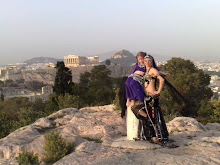
In Greece, Mom would glide from gig to gig through the streets of Plaka, and when I finally arrived in Athens, I walked each night by her side. She wore a long purple velvet cape covering her glittering costume and in her hand carried a sword in its scabbard. Every night waiters in the outdoor tavernas we walked by would yell out:

“Rhea! Are you going to KEEL ME WITH YOUR KNIFE?”

And other brilliant remarks in the same vein. Every. Single. Night.

http://www.gerlachstudio.com/p183.html


We would regally ignore them and keep striding, goddess-like, along, which was brilliant on our parts. I imagined that Athena was up on the Acropolis looking protectively down at us with her shield and fluttering little owl. Athena had our back should we ever actually need to 'keel' those waiters with our knife.

ATHENA WITH OWL, SHIELD AND SPEAR PROPS BY BEBESDUPOIRE

Nowadays, belly dance students sometimes rush to balance the blade before they have even learned to flow their dance without a prop, or adequately developed as artists. In their haste to show off a skill, they miss opportunities to create personal sacred balance ritual, to make magic with their prop. Some common mistakes: Dancers unceremoniously plop the sword on their head and then shimmy like speed demons. They try to make it look too easy, put their fingers all over the ‘sharp’ end of the blade and rush to show all they can do under the blade. If you’re going to put a prop on your head, take your time and treat the whole process with respect. You are enacting dance theater, an otherworldly, revelatory slow motion moment of power and drama in your dynamic dance repertoire.

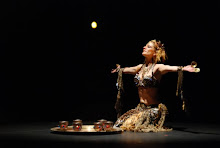
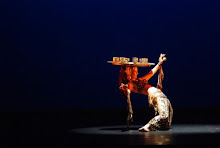
SUMMONING THE SACRED ENERGY FIELD BEFORE I BALANCE MY TRAY ON MY HEAD

Be present in the moment, take the time to practice and develop a real relationship with your prop, and be clear in your mind about what that relationship is. What is your dance story? What ideas and images are you projecting with your prop? Make sure your priority is still to be a good dancer who radiates awareness and presence under the blade. Above all, don’t let dorky people take your prop from you and run around restaurants slashing the air like pirates. Woe to those who touch my props without asking. And if you do ask, I will smile, say no, and secretly skewer you in my mind. If I offer to show you, that is another story. Like the international circus performers I have worked with and still learn from, I take props very seriously: they are alive; they are my livelihood. Like Athena’s shield, they are important extensions of myself and my craft. Word to the wise: never touch anyone's prop unless they offer. It's none of your business. It's their magic.

The first time I was asked to teach a seminar on balancing, I wasn’t sure whether to do it. I asked my mom what she thought, she said no. My mom had always made a point of NOT teaching sword balancing, figuring that people should experiment on their own. Her idea was that dancers should observe the craft and technique of established, expert dancers at work with their props then work things out for themselves, hopefully adding their own original ideas to their act. You never want to ‘lift’ ideas, undigested, from other dancers – you want to create your own original concoctions. I agree with her on that count, students don’t do enough observational fieldwork anymore (though perhaps with YouTube that is changing – its just sad there aren’t as many real, non-computer venues to frequent in order to see great dancers accompanied by a live band doing a real 5-part show as there were in the 70s). But I went ahead, thought things through for myself and taught the seminar anyway. I sat down to think through our ‘family secrets’ so I could translate them to the students in some organized, meaningful way.

In the end it felt a bit unsettling to reveal our trade secrets, but it was also liberating to share, and the response I got was gratifying. Students have told me they pinned my hand-outs above their mirrors for inspiration, and incorporated balancing work into their lives on a daily basis. They were being given permission to take risks, try things and be creative. With a sword on their head.

MELINA WITH SWORD

Process not Perfection

Learning to belly dance is like learning a new language -- you can't expect to speak it like a native speaker right away!  You learn a few words (movements) here and there, then develop the grammar of how to link the words, how to use punctuation and pause... and then slowly, with practice, you gain fluency. You start to drop stories about what this or that means, or how things are supposed to "look."

Relax into your body, reclaim yourself and enjoy the journey. And remember - once you are proficient, there is always still more to learn, especially if you want to create a poem with your dance and treat it as more than just a form you are filling out. Belly dance, like its infinity shapes and circular movements, is a lifelong discovery. When you stay curious, when you stay engaged with the process, it can lead you deeper and deeper into you.

I was so happy to find the following interview with Michael Cunningham from the book The Very Telling: Conversations with American Writers By Sarah Anne Johnson. Cunningham reinforces the notion of the artist as one who diligently follows the vein of their passion. Patience, perseverance, and fascination with the process itself are key to an artists' work:


“I’ve come to think that what we call ‘talent’ is inextricably linked to a bottomless fascination with the process itself, that an artist of any kind possesses, among other qualities, the desire to do it and do it until it comes out right.

It took me some time to understand that what I needed to do was not reform my natural inclinations, but to give in to them.

I’m not convinced that writers must only write about what they know, but I’m sure we should only deal with that about which we care passionately.

Have patience. Don’t panic.”

Belly Dance Marketplace

This piece first aired on NPR's Marketplace in 2003. I got to record it for the radio on location in the WBUR studios. I was told that in my speaking voice I had a "sibilant s" which is the first time I had ever heard that term. I liked the word and thought it should be spelled "sibyllant," like the Cumaean Sibyl. A prophetess, yessss. But no, my "s" sounds more like a hissing snake...which given the fact we are dancing the 'dance of the serpent' is entirely appropriate.

This photo was taken in 1978 at the Athens by Night Taverna where I performed every night with my mother Rhea of Greece. I was 8 or 9 years old.

Belly Dance Marketplace


My first lesson in economics came backstage at the Parthenon Taverna in San Francisco where my mom belly danced on Saturday nights. I was two years old, and already I knew exactly where money came from: it came right out of Mom’s coin girdle after a show. It was my job to pluck out the cash and count it up. One by one, I’d pull out the sweaty dollar bills, carefully uncrinkle them, and make humid piles of ten as she changed into her evening gown. The next day, we’d go to the supermarket and spend these same bills on fruit roll-ups and Ho-Ho’s – or at least that’s what I remember buying. Not only did I learn to count this way, but I intuitively knew that the number of grocery bags we carted home was in direct proportion to the amount of tips Mom had made the night before. She was a popular dancer, which translated to a lot of groceries in the trunk of our Morris Miner.

During that same year I made the more personal connection between shimmies and cash. One night I decided it was time to take to the raised stage with a costume pinned to my diapers. Audience members, beside themselves before the spectacle of this diminutive toddler belly dancer, leapt to their feet to tuck tips into my Lilliputian hip scarf. Among these admirers was a little boy, sent up by his parents to add to my wealth. Upon seeing my cash bounty waving gaily at him from my costume, the boy sought instead to make a cash withdrawal. We wrangled over the money and I won, of course. My mother didn’t teach me to sit back and just let things happen to me. I learned early that once having acquired money, you must fiercely protect it to prevent its loss.

It wasn’t until the age of seven, after Mom had moved to Greece, that I began to dance professionally in earnest. The currency was now foreign, but the fiscal concept was the same: if I danced during Mom’s performance, she would pay me 100 drachmas a night. Since I enjoyed dancing and preferred to be up on stage with Mom rather than getting my little freckled cheeks pinched by the Greek waiters in the kitchen, it worked out rather well. Plus I learned that if you saved up your money over time, you could buy things that really mattered. By the end of the summer I had it all: a bicycle, a bracelet, and lots of magazines with Charlie’s Angels on the cover.

The one thing that Mom never really taught me about was banks. For whatever reason, we saved our money in hats, boxes, books, hollowed out cabbages in the fridge. Our cash may not have earned interest, but it did gather dust and mold. Eventually I learned that a penny saved is just that: a penny saved. I stopped saving up to buy stuff and learned to love the process of just saving up, watching my stash grow, thinking that eventually I might need it for something really important and I’d be able to provide it for myself. Indeed, my childhood belly dancing earnings quickly got swallowed by my college tuition bills, but I’m pretty sure it was worth it: after earning a B.A., M.A. and PhD in French Literature, I’m back to belly dancing for a living (that's a whole other story!)


The Marketplace essay had to be very short and ended there, but here are more of my thoughts on tipping that could come in handy for dancers or audience members. Aha - finally we reach the crux of the double meaning of my blog, "Tips from the Hip." OK I will spell it out: I am passing on "tips" about what I have learned about the nature of "tips" (money given by audience members as appreciation for a belly dancer's performance). These tips are things I learned from a childhood dancing literally at the hip of my mother, who also received tips in her hip. Have I beat this double entendre to death or what?


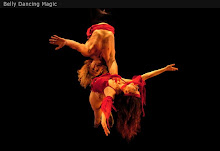
In the belly dance world, tips can be a hotly contested practice with two major camps:  those who accept tipping as part of their dance performance and those who do not. There are valid reasons to stand on either platform and I respect everyone's choice especially if they have thought it through. I stand with my mother, my sister, and the long tradition of cabaret belly dancers who do accept body tipping at the hip, as long as there are off-limit zones and the practice is done tactfully and with humor, dignity, cultural sensitivity and wit. Belly dance has long struggled to attain a reputation as an honorable art form, as important, reputable and well-considered as ballet, modern and jazz dance.  Great belly dancers have worked hard in this country and others to elevate the art of belly dance and bring it to the theatre stage, removing it from the lively taverna atmosphere and cleansing it of its "hootchie kootchie" dance reputation from the time of the World's Fair in the 1800s.  My sister Piper did her part in this by founding the BellyPalooza festival in Maryland and staging the "Belly Dance Magic" Show at the Baltimore Museum of Art theatre.  My mother Rhea always does her best to rebel in these more rarified settings by leaping from the stage and dancing into the audience for a more immediate transfer of energy.   She hates how theatre lights blind her and always makes the lighting guys put on the house lights when she dances -- she wants to see the audience and her affect on it.  Guess which dancer got a standing ovation in the last Belly Dance Magic show!  You can take Rhea out of the taverna but you can't take the taverna out of Rhea!  

There is something magic about the taverna context and the community aspect of the tipping ritual. This is the time where the audience can show off to their friends and display their wild good natures, their wealth, their appreciation of the dance artist and join in the dance.  Instead of passing the hat, belly dancers are given money showers, money necklaces, or respectfully tipped at the hip.  If money falls to the ground we dancers do not stoop to pick it up with our hands - this is considered very bad form.  Tipping time is often an expected part of the dance in a taverna / restaurant context, and the dancer must be a superb diplomat in nonverbally guiding the audience to the most respectful way to tip her.  She must understand different cultural mores.  When I haven't "gone around for tips" customers have mournfully approached me later with the reproachful "you didn't come around to our table," and pressed a crumbled bill into my hand.  

The art of going out for tips is a performance unto itself, where the dancer must be able to read the make up and mood of each table, decipher what country they might be from, divine who is the one everyone would like to see celebrated or teased, understand who would like to get up and dance, who would prefer to stay seated, and who would, after protesting they don't want to dance, actually secretly enjoy be dragged on to the stage. You can learn a lot by just placing a hand lightly on a shoulder and reading the person's energy. If it resists and is hard as a rock, better leave the person alone. If you sense a movement, pliability... they want to come and dance!

Tipping time is the ultimate improv situation.  The dancer must be ready for anything. She must be gracious and quick -- and above all, not act like it is about money, for in the end, it is not.  It is about the ritualized interaction between a modern day goddess and the audience who has just been transported by her hip work and grace to another dimension.  

I always tell dancers I mentor: Never count your money in front of the customers!  Never pick up tips that fall to the ground!  Never leave your tips unattended in the bathroom.  Never let your boyfriend collect your tips.  Always tip others who help you.   Beware little old ladies who lean in to tip you in your bra strap.  One elderly woman once knuckled my nipple when I least expected it.  I didn't waste my energy getting pissed off -- I just laughed it off and moved on, marveling at the new ways I realize I must be on guard when I'm in the tip zone.  Spectators, please don't tip me when I'm balancing a tray of lit candles on my head, the fire is real and the tray is not held on by glue!

Tipping is the ultimate landscape for social anthropological study. What type of person will first tip the dancer? Whoever you are, we love you! If they leap to the stage and shower you with a stack of bills, goddess bless them!  Others follow suit. If they come up on stage with a $20 bill and respectfully tuck it into your hip for all to see, goddess bless them!  Others may follow suit.  If they wave a $1 like its the Hope Diamond and summon you over whispering "this is for you if you take care of my friend over there" - whoosh!  You will see Melina disappear from your orbit leaving the dollar waver still gripping his dollar which is now fluttering in her wake.  If you find little kids trailing you like the pied piper -- train them to pick up all your tips and put them into your prop box -- goddess bless them!  Don't linger by patrons who haven't tipped you or lunge for money just because its held out.  Dance, laugh and keep it family friendly.  

I have uncrinkled steaming money from every country of the world.  It connects me to the world and the world to me.  It is an honest tangible exchange.  I learned the many techniques of dealing with tips and tipping from watching my mother, who has a knack for humor and human relations.  You learn how to engage, who to ignore, and when to run.  


Melina's belly dance and circus arts studio is Moody Street Circus in Waltham, MA. Ongoing classes in the dynamic, organic Daughters of Rhea "vintage oriental" style - check studio calendar for listings.

Breathing and belly dance

We all tend to hold our breath when learning new techniques in any movement discipline. I even find myself holding my breath when I'm plugged into the computer in the course of my cyber business, stopping my inner flow and bracing as I bump along the choppy internet river. And its true, in belly dance there is a lot to keep track of -- like how are you standing? What's going on with your pelvis - where is it looking? Are your knees rotating inward or outward? What part of you is bearing the weight? If one arm is up in the air looking gorgeous, what is the other hand doing? Is it a dead energy hand, dangling by your side in sad neglect? What part of your body is initiating a movement? Tune into the whole of your dancer self, from feet to top of head, through hands and arms. The path I take is breath. Breathing into all parts of you to keep everything energetically pulsing, even if its just a gentle, relaxed charge. In the warm up I try to tune everyone into how to stand and to go inward, following the breath inside of the body as the lungs fill, then exhaling fully while visualizing and locating our center. Relax, center, pay attention to your inner workings, and your outer expression will sing more beautifully.

Poetic Testimonial

“Women in Melina’s classes will embrace a new physicality that combats forces of depression and releases unadulterated joy!” --Nassim Assefi, M.D.

PiperMethod YouTube Channel

Belly Dance Homework in between classes with your regular teacher!
Want to work on fine tuning your belly dance technique?
Visit my sister Piper's YouTube channel PiperMethod and hone in on the details of your dance technique.

Jareeda Magazine Interview with Melina by Morgana

Morgana's Interview with Melina of Daughters of Rhea
Published in Jareeda, December 2002

1) There's been a lot of debate in our culture about how divorce affects children; in your writing, you express that although you felt a lot of heart ache, you feel blessed that you had such an adventurous childhood, traveling around and experiencing so many different cultures.


My parents separated before I was out of diapers. To this day I can’t imagine them as a couple and never wished they were. Like most children, I was resilient and accepting of the way things were. I benefited greatly from their personal and professional life choices, their unconditional love and their commitment to involving me in all aspects of their lives. Because of them I was exposed from birth to a vibrant and diverse slew of countries, cultural settings, ways of life, and artistic and intellectual milieux. I was equally comfortable in Greek tavernas, communes in Berkeley, circus tents, Aegean islands, New York subways, bohemian intellectual gatherings, folk music jams and feminist belly dance circles. By the age of 10 I knew how to perform for live audiences, turn cartwheels in a circus ring, belly dance with a tray of lit candles on my head before hundreds of tourists, converse with adults, and change planes by myself in Amsterdam. In the midst of all the changes and transitions, I would plant myself in the pages of a book to find my center - books were where I anchored myself. But the ultimate truth is that I am lucky to have such humorous, creative & spiritual people for my mother and father.


2) Since you also had a rich experience as a circus performer, do you feel that has influenced you as a Middle Eastern artist and vice versa? Do you feel that performers benefit by "cross-training" this way in different disciplines?


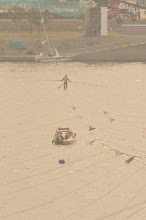
No matter what the theatre, an audience can feel it when you are expressing your fullest, most confident and expansive self. The more tools and skills you can summon for a performance, the better. Of course, context plays an important role, as you want to tailor the way you perform to fit the setting. As a circus performer you have to play to an audience of up to 1600 people. You have to project your energy, your skill and your joy beyond the ringside VIPs all the way up to the kid sitting with her popcorn in the highest bleacher. You need to rivet their gaze from the moment you step into the ring, and so you learn to take your time, be larger than life, dramatic and unrestrained. You also have to be completely spontaneous and ready for anything as there is a lot going on in the circus ring that you have no control over. You have to be ready to reinvent the “script” if someone messes up a trick, or if the clown you are dancing with misses his cue, or if the elephant pees in the ring, or if your juggling act falls apart because people keep dropping clubs. You must dance on, dance on, and dance on... The audience needs to see that everything is all right, that you are OK and in charge.


I also learned a lot about costuming, make-up and self-presentation from watching the Flying Wallenda family both on the high wire and behind the scenes. Their example inspired my home-sewn belly dance costumes to get more sparkly and theatrical, my make-up more exaggerated, and my stage presence more dramatic. I also learned to use my voice and cymbals to maximum effect in the ring. The circus teaches you to use whatever means are at your disposal to create transformative energy and to draw the audience’s eye to the show. The circus is also a great place to combine skills, which for me has resulted in interesting new dance ideas. I sometimes like to integrate juggling, acrobatics, tambourines, & balancing into my regular belly dance performances and troupe choreographies. Yes, performers of all kinds benefit from “cross-training”.


3) Living and performing in Greece as you and your mom and Piper have, how does actually living and working in an eastern culture affect what you bring to the stage as a dancer?


No matter what corner of the globe they hail from, human beings respond well to dancers who project professionalism, confidence, their authentic selves & good dance technique. Growing up in Greece and understanding Greeks and how they interact means that I do know what Greeks like, however, and has helped me connect with and please Greek audiences.


4) You describe education such as your PhD in French medieval literature "as a stabilizing influence" in your life. Please explain more about that.


No matter how many changes and displacements I experienced as a kid, I could always depend on books and on the structure of academic life to bring a comforting and predictable rhythm to my otherwise itinerant life. As a nomadic child, books were my anchors, narrative constants as I chartered back and forth between the wildly disparate worlds of my mother and father. My natural love of learning, of books, of foreign languages, of literary history and criticism, and of writing led me to pursue a PhD in French Literature. The Ivory Tower has always been a refuge when I needed it, but I wouldn’t want to be stuck there forever: I also like to descend the tower and shimmy.


5) Please also tell about your desire to study French medieval literature, and if you think the sentiments of that literature have had their own impact on you as a performer.


I think it would take a book to fully explore my response to this question! From early childhood I immersed myself in literature, from the mythic poems of Homer to the weird and magical worlds of Madeleine L’Engle, Raoul Dahl and Frank L. Baum. I also liked stories of how words and a discovery of writing could change lives from the inside out. As a literature major at Wellesley College I wanted to explore the power of words and the various transformative modes of female self-expression. I wrote my undergraduate honor’s thesis on Marguerite Duras and the intertwined themes of female subjectivity, self-expression and writing. Later in graduate school at UPenn I wrote my doctoral dissertation on the interplay of old age, female authority and the representation of the female body in late medieval French literature. Being a scholar and writer has only enriched my life as a dancer and performer. I am very attuned to the ways society constructs and limits human beings by gender and age stereotyping and I enjoy resisting convention and (artfully!) innovating as much as possible with belly dance. I am always conscious of the story I am telling with my dance, and I like my performance to transform or energize the viewer in some way. Bottom line is I want the audience to go home feeling inspired and positive.


6) Some people do seem surprised when they learn that an Oriental dancer has an advanced degree of study, despite the fact that there are doctors, professors, anthropologists, journalists and all sorts of professionals doing Oriental dance. Do you think there is pressure for dancers on the professional dance track to downplay their intelligence or education?


I hope not. No one should ever have to deny the full spectrum of their experience to serve the needs of narrow-minded people and their misguided notions about Oriental dancers.


6) Coming from a family of dancers, how does one balance the fact that dance runs in the family with creating ones' own identity as a dancer?


I never consciously created my own ‘dance identity’, it just came about naturally. In our family it was the norm to dance for fun and profit. Piper and I grew up in the Land of Belly Dance Art & Biz, and we navigated that land easily from a young age. Mom encouraged our maximal self-expression as dancers and celebrated our strengths and differences. In both life and dance Mom, Piper and I have learned from each other in immeasurable ways – we are stronger as individuals and as dancers because we have each other.


7) Now that you're a mom, to Zoë, how (if at all) has that affected your feelings about your own mom, and everything that goes with being a mom? Do you see some of your upbringing with a different perspective now?


I appreciate my upbringing and my mother’s choices even more now that I am a mom. My childhood was so enriching and wild! I was given such incredible gifts – a love of dance, bravery, the knowledge that if a door closes a window opens somewhere else, an open mind and heart – this is the legacy I want to pass on to Zoë.


8) Even though she's still a toddler, Zoë seems quite comfortable already in the atmosphere of Middle Eastern music and dance. Is it your hope that she will follow in your and your mom's and sister's footsteps?


Yes, dance is already an integrated part of Zoë’s life, as natural a function as breathing. Every morning she heads to the dance room of her own accord for a little free style twirling. Her father makes her little costumes and we cart her around to my early-night gigs and belly dance festivals. But like my mom did with me, I will never force the dance on Zoë. It will however always be there for her if she wants it.


What if she decides when she's older that this is not for her and chooses a different path?


Zoë Isadora is free to choose her own path in life. Zoë means life in Greek, and life is unpredictable, wild, exciting, fulfilling and in the best case filled with love. Her middle name, Isadora, is from the dancer Isadora Duncan, a brave and independent free spirit and innovator who reminds me of my mother. I have a feeling that no matter what path she chooses Zoë will be original and determined, because this is the DNA that runs in her blood! So Zoë could be a librarian, the president, a CEO, an engineer, a writer, a dancer, a therapist, a slacker. Who knows. I had no restrictions put on me growing up in terms of future professions or life paths. I was given opportunities, my intuitions were honored, and my natural inclinations were nurtured. And this is all I wish for Zoë: a sense of many possibilities, a cushion of unconditional love, many avenues of self-expression to choose from, confidence in herself, an attitude of kindness and humanity towards others, and an ability to access and honor her inner voice.


9) Some people, even people who've had adventurous lives, say they feel a lot more conservative once kids come along -- or that they wouldn't feel comfortable if their children took the same risks they did. When you think about the adventurous life that you have and have had, does that have an effect on your feelings as a mom?


I am not more conservative now that I’m a mother. In fact I’m probably less conventional now than ever before. But I have always been a responsible soul. Its not like my adventurous upbringing was full of life-threatening risk or anything, it was just artistic and weird, and I still like things that are artistic and weird. I can’t say exactly how I’ll feel every step of the way as a mother to Zoë, but I do believe that she is her own person and will be taking responsibility for her own life choices.


Are there any final thoughts you'd like to share about dance, about motherhood, daughterhood and sisterhood, and about your rich and full life? Any thoughts you'd like to pass on to other dancers in pursuit of their dreams?


Besides saying that my daughter, my sister and my mother rock! And that for me some of the keys to life and dance are thinking through your choices, maintaining a sense of humor in the face of disagreement, taking risks, flouting convention, and never putting others down, I would like to share excerpts from my Daughters of Rhea mission statement. I see Oriental Dance as one way to reach toward and perpetuate the beauty of the world. My goal is to encourage women’s unique expression of their wild, most ecstatic selves through the ancient art of belly dance. With this dance I want to celebrate life, creativity and community. I want us to be in our bodies with pride, awareness and open hearts. I want us to couple technique and precision with enthusiasm and passion, to be industrious in practice so we can be Dionysian in performance, and to be open to transformation and revelation at every stage of our dance career. I also want to say this: My 33-year old brother-in-law has Lou Gehrig’s disease and is confined to a wheelchair. His prognosis is not good. He can no longer dance, and so I dance for him. I use this dance to raise money for a cure and to spread awareness about the disease. I exhort everyone to dance because you can, to dance because your body wants to dance, to dance because life is short and it is one of the best ways to spend your time. And stop worrying about what everyone else thinks. Dance your dreams no matter what.